

Summary
Positioning Greenland as an autonomous part of the Kingdom of Denmark: status, institutions and the division of competences
Setting out the structural realities: sparse settlement, difficult accessibility and infrastructure as binding constraints
Overview of foreign and security-policy integration, including concrete points of relevance for Germany/the EU
Overview
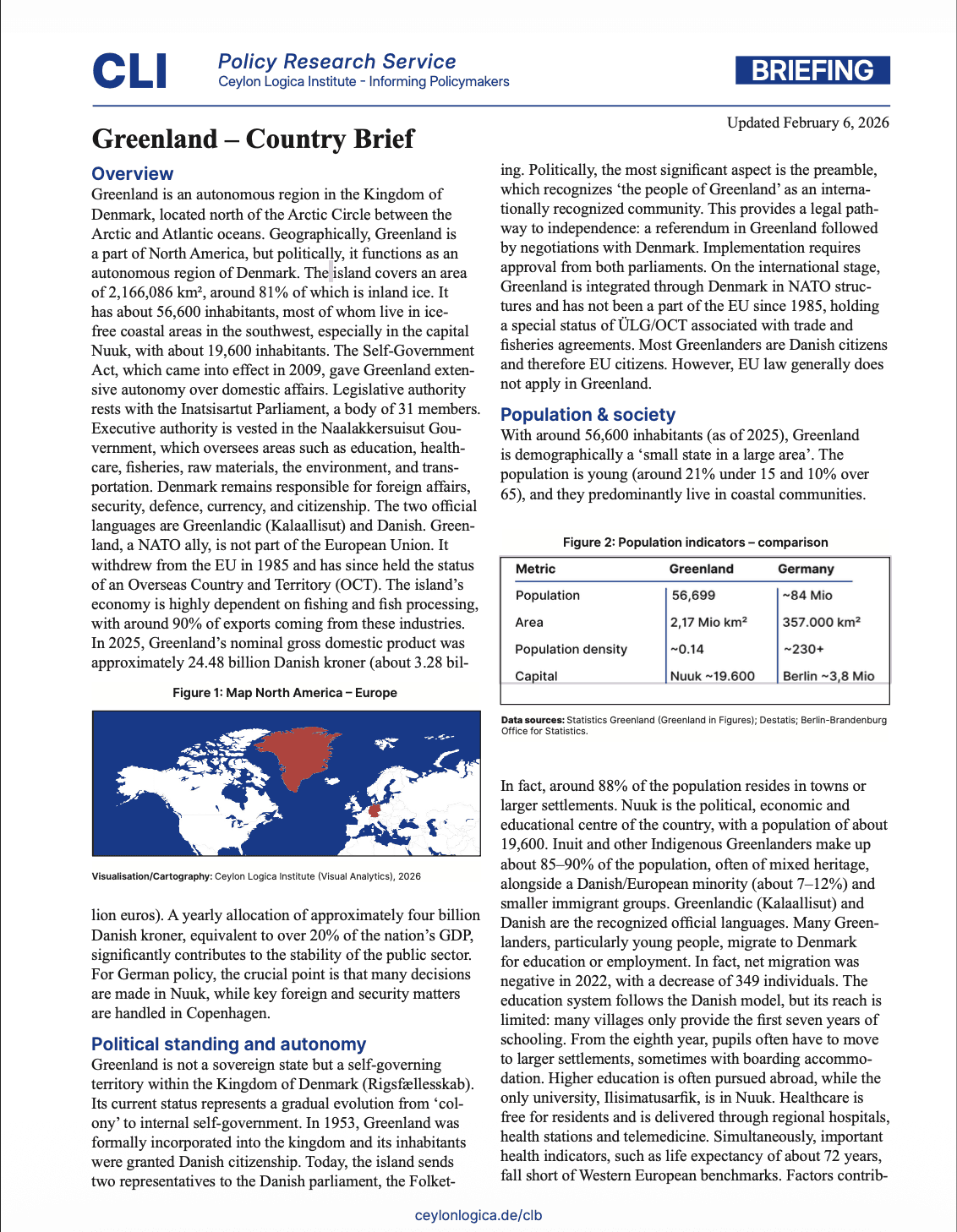
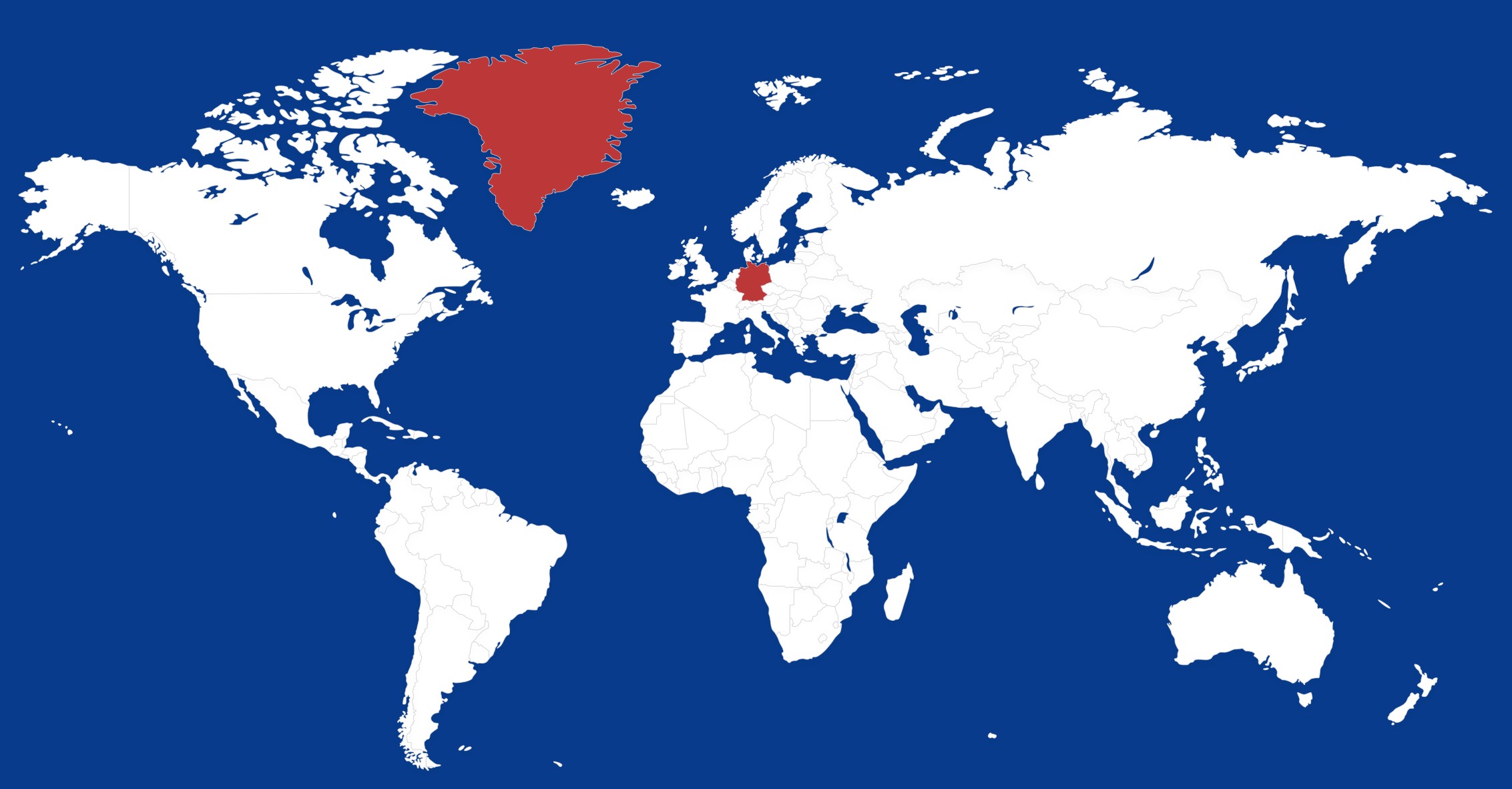
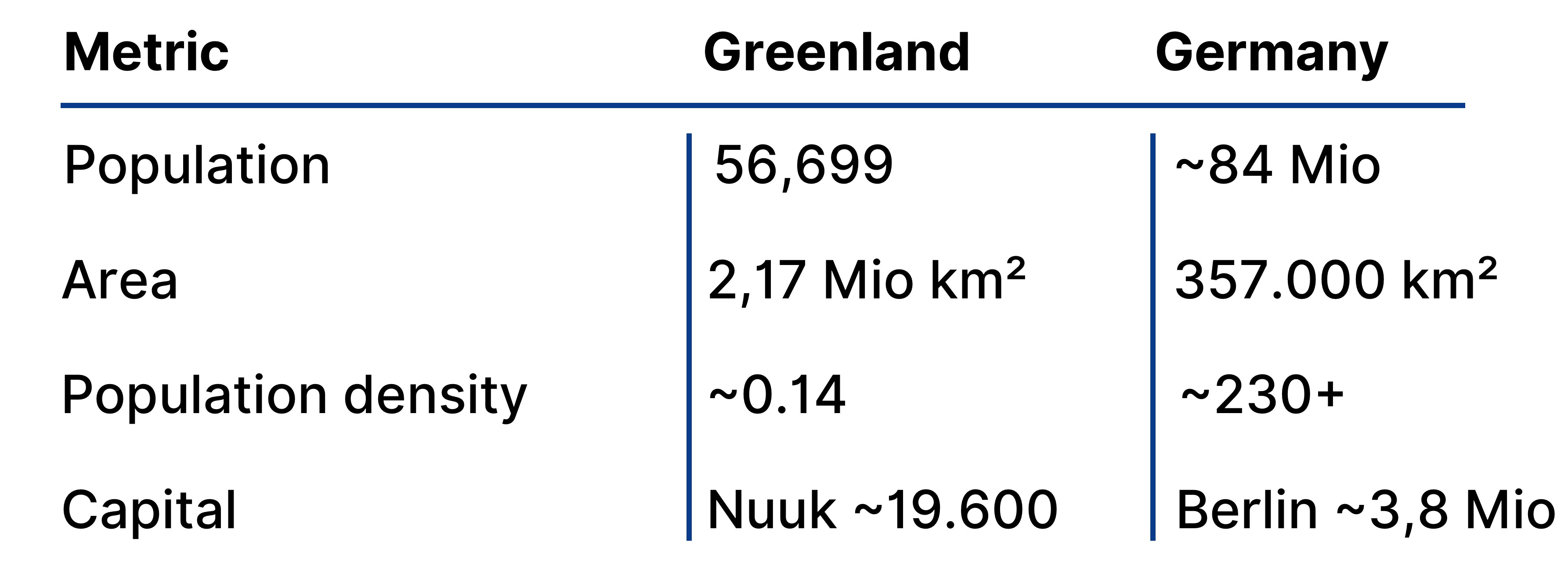
Greenland is an autonomous region in the Kingdom of Denmark, located north of the Arctic Circle between the Arctic and Atlantic oceans. Geographically, Greenland is a part of North America, but politically, it functions as an autonomous region of Denmark. The island covers an area of 2,166,086 km², around 81% of which is inland ice. It has about 56,600 inhabitants, most of whom live in ice-free coastal areas in the southwest, especially in the capital Nuuk, with about 19,600 inhabitants. The Self-Government Act, which came into effect in 2009, gave Greenland extensive autonomy over domestic affairs. Legislative authority rests with the Inatsisartut Parliament, a body of 31 members. Executive authority is vested in the Naalakkersuisut Gouvernment, which oversees areas such as education, healthcare, fisheries, raw materials, the environment, and transportation. Denmark remains responsible for foreign affairs, security, defence, currency, and citizenship. The two official languages are Greenlandic (Kalaallisut) and Danish. Greenland, a NATO ally, is not part of the European Union. It withdrew from the EU in 1985 and has since held the status of an Overseas Country and Territory (OCT). The island’s economy is highly dependent on fishing and fish processing, with around 90% of exports coming from these industries. In 2025, Greenland’s nominal gross domestic product was approximately 24.48 billion Danish kroner (about 3.28 billion euros). A yearly allocation of approximately four billion Danish kroner, equivalent to over 20% of the nation’s GDP, significantly contributes to the stability of the public sector. For German policy, the crucial point is that many decisions are made in Nuuk, while key foreign and security matters are handled in Copenhagen.
Political standing and autonomy
Greenland is not a sovereign state but a self-governing territory within the Kingdom of Denmark (Rigsfællesskab). Its current status represents a gradual evolution from ‘colony’ to internal self-government. In 1953, Greenland was formally incorporated into the kingdom and its inhabitants were granted Danish citizenship. Today, the island sends two representatives to the Danish parliament, the Folketing. Politically, the most significant aspect is the preamble, which recognizes ‘the people of Greenland’ as an internationally recognized community. This provides a legal pathway to independence: a referendum in Greenland followed by negotiations with Denmark. Implementation requires approval from both parliaments. On the international stage, Greenland is integrated through Denmark in NATO structures and has not been a part of the EU since 1985, holding a special status of ÜLG/OCT associated with trade and fisheries agreements. Most Greenlanders are Danish citizens and therefore EU citizens. However, EU law generally does not apply in Greenland.
Population & society
With around 56,600 inhabitants (as of 2025), Greenland is demographically a ‘small state in a large area’. The population is young (around 21% under 15 and 10% over 65), and they predominantly live in coastal communities. In fact, around 88% of the population resides in towns or larger settlements. Nuuk is the political, economic and educational centre of the country, with a population of about 19,600. Inuit and other Indigenous Greenlanders make up about 85–90% of the population, often of mixed heritage, alongside a Danish/European minority (about 7–12%) and smaller immigrant groups. Greenlandic (Kalaallisut) and Danish are the recognized official languages. Many Greenlanders, particularly young people, migrate to Denmark for education or employment. In fact, net migration was negative in 2022, with a decrease of 349 individuals. The education system follows the Danish model, but its reach is limited: many villages only provide the first seven years of schooling. From the eighth year, pupils often have to move to larger settlements, sometimes with boarding accommodation. Higher education is often pursued abroad, while the only university, Ilisimatusarfik, is in Nuuk. Healthcare is free for residents and is delivered through regional hospitals, health stations and telemedicine. Simultaneously, important health indicators, such as life expectancy of about 72 years, fall short of Western European benchmarks. Factors contributing to this include accidents and suicides, although rates in very small communities can vary significantly.
Geography and Settlement Patterns (154 Words)
Situated north of the Arctic Circle and bordered by the Arctic and Atlantic Oceans, Greenland holds strategic importance. With a land area of approximately 2.16 million square kilometres, it is the world’s largest island. An inland ice sheet up to three kilometres thick covers about 81% of this area, leaving a narrow, ice-free coastal strip suitable for habitation. As a result, human settlement clusters along the coastline. All communities are near the sea. Harbours, fisheries and air links largely determine where permanent settlements develop and where administration and services are concentrated. The majority of the population and infrastructure are in the south-west, with more than a third of residents in Nuuk and around 88% of the population living in urban areas. There are no road or rail connections between towns and villages, so people and goods move by ship or boat, snowmobile, aircraft or helicopter. Logistics is not a peripheral matter in Greenland, but rather a crucial aspect of its political and social landscape.
Economy & public finances
Greenland’s economy is modest in size, yet remarkably resilient due to government subsidies and a substantial public sector. In 2025, Greenland’s nominal gross domestic product (GDP) was about 24.48 billion Danish kroner (approximately 3.28 billion euros), which equates to around DKK 280,000 per person (about 37,000 euros per capita). Two industries hold a significant presence: fishing and fish processing, as well as public services. Exports are largely driven by seafood, particularly prawns and halibut, which contribute around 90% of revenue. Diversifying the economy remains a long-term policy objective. Mining and raw material projects exist, but current extraction is limited; several large projects have been halted for environmental and regulatory reasons. Tourism remains a niche market (about 150,000 visitors in 2025), but it is intended to expand thanks to improved accessibility. To this end, the government of Greenland, Denmark, and the Nordic Investment Bank are investing in the expansion of several airports, the largest infrastructure project on the island. The total cost is around one billion US dollars.
External Relations and Security
Greenland has not been a member of the European Union since 1985, but it maintains a unique status as an ‘Overseas Country and Territory’ (OCT), with particular advantages in areas such as partnership and fisheries. Greenlanders hold Danish passports, and the capital, Nuuk, has its own representative offices in cities such as Brussels and Washington to advocate for its economic interests. Political ties with Germany are primarily facilitated through Denmark and EU-wide forums, with an EU office in Nuuk established in 2024 to further strengthen these connections. Greenland has been a part of NATO through Denmark since 1949. A defence agreement between Denmark and the United States, signed in 1951, allows for a US presence on the territory. The Pituffik base, formerly known as Thule, houses early warning and space surveillance systems. Greenland does not possess its own military. Instead, Danish forces, including the Arctic Command, the Coast Guard and the police, are primarily responsible for ensuring maritime presence and sovereignty enforcement.
Germany/EU linkages
Germany’s involvement in Greenland’s politics mainly occurs through Copenhagen and the European Union. This is because Greenland is part of the Kingdom of Denmark, but not a member of the EU. Since leaving the European Community in 1985, Greenland has held the designation of an overseas country or territory (OCT; ÜLG/OCT). The EU is increasing its local presence: in March 2024. Previously, the European Parliament had called for stronger links between Greenland and the EU. In parallel, the raw material dimension is gaining importance. In November 2023, the EU and Greenland agreed on a letter of intent on critical raw materials, focusing on sustainable value creation and reducing dependencies. Although Germany’s direct links with Greenland remain relatively limited, they are tangible. In 2024, the country imported a significant amount of processed fish and meat products from Greenland, valued at approximately 22.5 million euros. Additionally, political exchanges between the two nations are on the rise. A delegation from the Deutsch-Nordischen Parlamentariergruppe of the Bundestag, led by Ingo Gädechens (CDU/CSU), made a visit to Nuuk from 27 October to 2 November 2024. It had discussions with members of the Greenlandic Parliament’s various committees, as well as with researchers, including those from the university and the ‘Arctic Hub’ network. Topics ranged from the economy and natural resources, to foreign, security and defence policy. The purpose of this trip was to obtain current insights, strengthen ties, and foster collaboration, particularly in areas such as climate, energy, and modernization. The delegation also included Laura Kraft (Grüne), Anja Schulz (FDP), Ariane Fäscher (SPD) and Stefan Seidler (SSW).
Last Updated: Mar 21, 2026